


In this keynote lecture, presented at WOS 2026, Prof. Flammer explains why Flammer syndrome is a risk factor for normal-tension glaucoma and other diseases:
The importance of ocular blood flow in glaucoma has been discussed in detail in another webpage:
https://glaucomaresearch.ch/en/
If a glaucomatous optic neuropathy (GON) occurs or progresses despite a normal intraocular pressure (IOP), it is called normal tension glaucoma. Ocular blood flow disturbances have been suspected to be involved since decades. Indeed many studies have proven a relationship between IOP and arteriosclerosis and its risk factors. However, rather surprisingly, at a given IOP, these factors do not or not relevantly contribute to GON.
The breakthrough in understanding the relationship between blood flow and GON came with observation that a constant reduction of blood flow, as we see e.g. in subjects with arteriosclerosis, is quite well tolerated. If the reduction is marked it can lead to a so called bland atrophy, but not to GON. GON is, however, induced by unstable oxygen supply due to instable blood flow. And a major cause of such blood flow instability is a defective autoregulation as it occurs in subjects with Flammer Syndrome.

This graphics illustrates in a simplified way the relationship between blood flow deficiency and glaucoma. While people with risk factors for arteriosclerosis have an increased risk for an increase in IOP and therefor also for “high tension glaucoma”, people with Flammer syndrome have an increased risk for both low blood pressure and a defective autoregulation and therefore also for normal tension glaucoma.
The pathogenesis of GON is principally the same in normal tension glaucoma as in high tension glaucoma.
The various risk factors have varying degrees of influence depending on the type of glaucoma. Flammer syndrome is often associated with normal-pressure glaucoma and less frequently with high-tension glaucoma. Arteriosclerosis, on the other hand, is rarely associated with normal-tension glaucoma and frequently with high-tension glaucoma, because the risk factors for arteriosclerosis are also risk factors for increased eye pressure. These relationships are illustrated in the pathogenetic concept shown below.

GON has two basic components: Loss of retinal ganglion cells and a tissue remodeling. Two processes play a major role thereby, the activation of astrocytes and the oxidative stress. The latter is mainly due to unstable blood flow. Blood flow is unstable when intraocular pressure fluctuates at a high level or blood pressure fluctuates at a low level, because then the capacity for autoregulation is exceeded from time to time. Blood flow is also unstable when autoregulation itself is impaired, as is the case in many patients with Flammer syndrome.
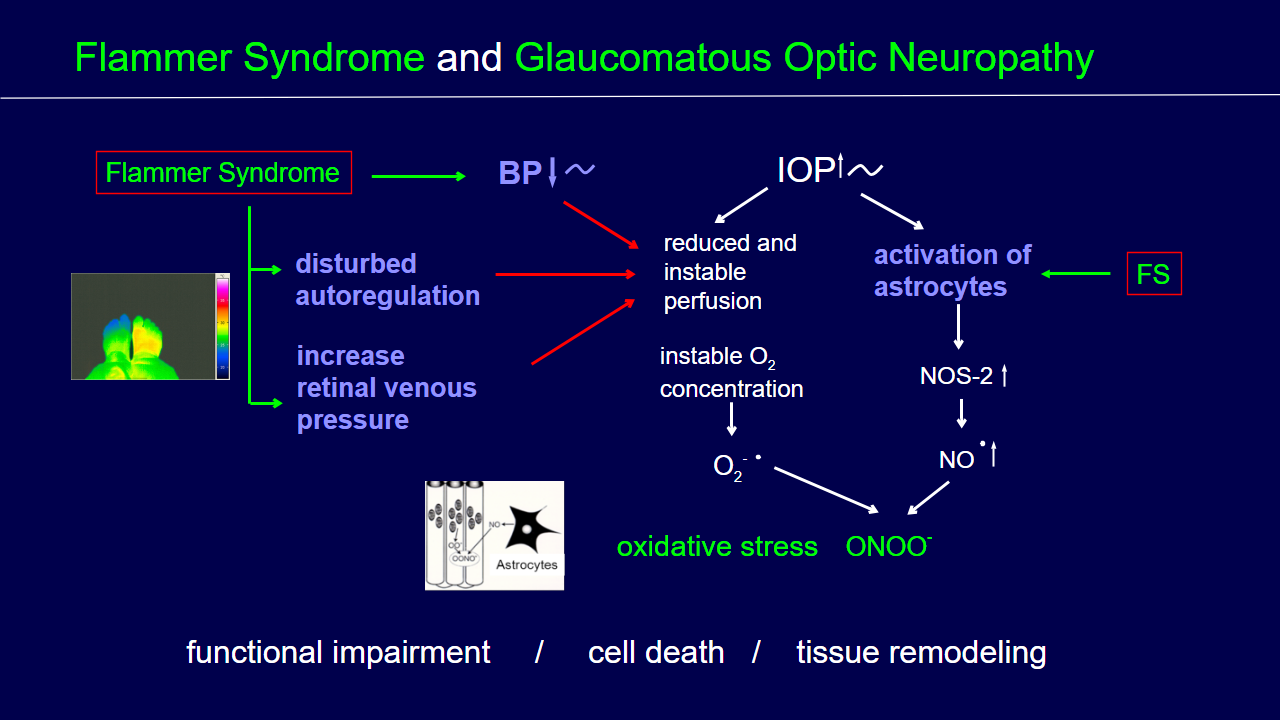
People with Flammer syndrome are more likely to suffer from glaucoma damage because they often have: lower blood pressure, impaired autoregulation, increased retinal venous pressure, and activated astrocytes.